


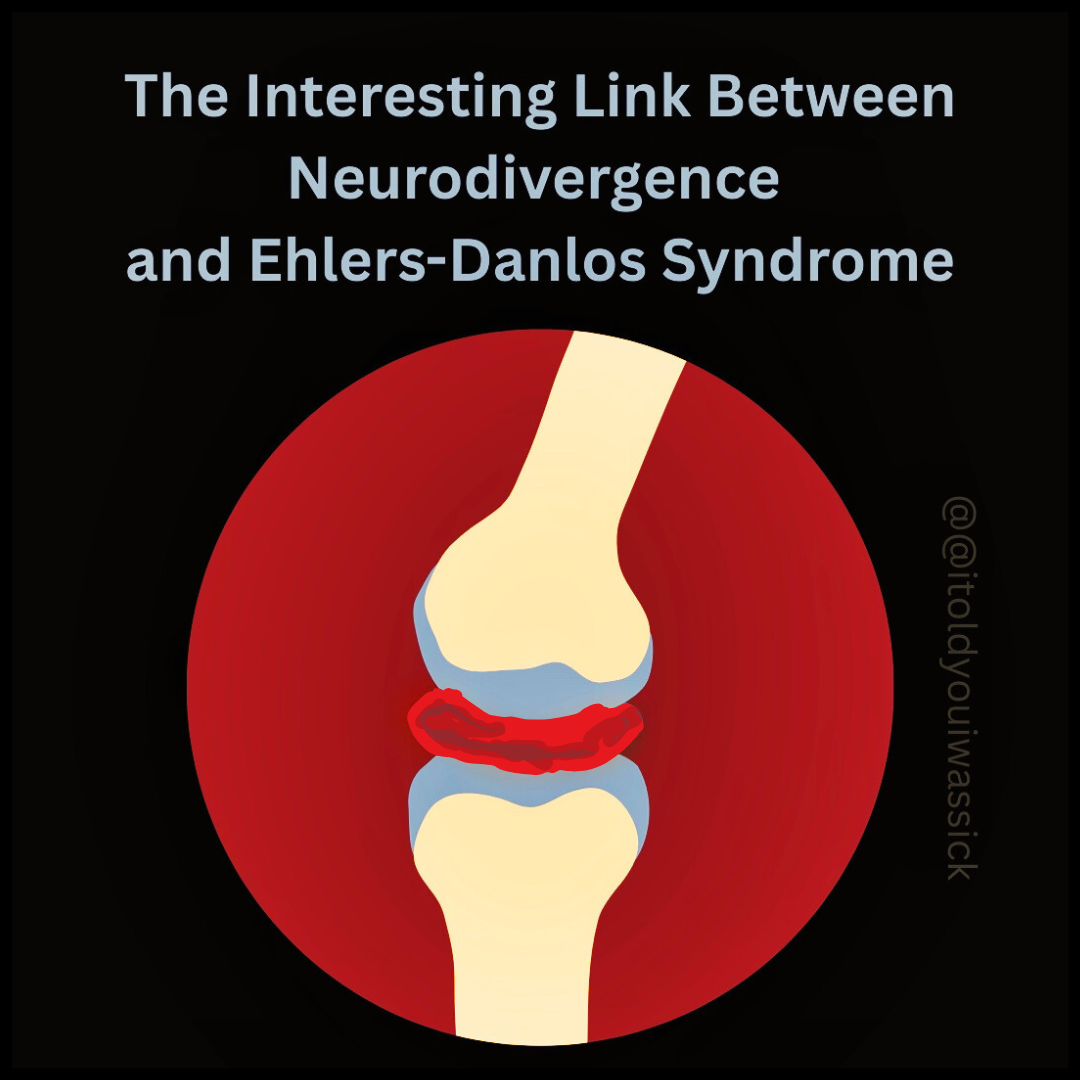
The Interesting Link Between Neurodivergence and Ehlers-Danlos Syndrome

The link between neurodivergence and chronic disorders keeps those observing coming back to the same idea: the world isn’t built for everyone’s operating system. In fact, it doubles down, challenging people two or three times over.
Case in point: Ehlers-Danlos Syndrome (EDS). EDS is an inherited illness affecting the body’s connective tissues & overall mobility. It presents a vast list of grimace-worthy symptoms, such as hypermobility, stretchy (but fragile) skin, chronic pain, and poor body fortitude.
Moreover, it’s heavily linked to neurodivergence, especially issues like OCD, ADHD, and autism.
The combination of this connective tissue disorder and a neurological condition makes for an unfortunate cocktail that no one orders and no one can send back. With no cure nor neat solution, there’s only the slow work of learning how to function while carrying it.
Many autistic people experience both hyper- and hypo-sensitivity. When that sensory imbalance intersects with an EDS-related symptom – let’s say, the digestive dysfunction of swallowing difficulties – the effects compound. A body already struggling with mechanics is filtered through a nervous system that registers sensation too loudly or not enough… all unpredictably. What gets dismissed as “picky” or “anxious” is often a nervous system responding accurately to a body that isn’t cooperating. These physical and psychological consequences manifest in high levels of discomfort, propelling a vicious cycle of instability.
What gets dismissed as ‘picky’ or ‘anxious’ is often a nervous system responding accurately to a body that isn’t cooperating.
Neurodivergence doesn’t only mean autism. ADHD doesn’t show up alongside EDS politely or in isolation. It threads itself through pain, fatigue, and physical instability, blurring the line between cognitive distraction and bodily interruption. Focus fractures not because of a lack of discipline, but because attention keeps getting rerouted to a body that won’t stay quiet. In this context, “managing ADHD” isn’t about productivity hacks or better planners, rather centered around properly negotiating bandwidth in a crazed system.
But why? Why do many of those with EDS also fall within the label of neurodivergence? A group of scientists dove into the complex relationship of the shared gene pool between the two. Essentially, the genetics of hypermobility (fragile X syndrome) present themselves as a trigger for more fragile X-associated disorders: “Neurodevelopmental issues in EDS may also be related to proprioceptive impairment, which alters coordination and posture, and likewise may be involved in the acquisition of verbal communication and motor competence” [1]. Simplistically put, neurodivergence and EDS overlap, like tacos and a margarita.
Another factor driving the ‘dinner combo’ is masking. People with EDS and neurodivergence frequently learn to override pain, suppress sensory distress, and perform functionality long before they receive names for what they’re experiencing. Physical masking looks like pushing through instability. Cognitive masking looks like compensating for executive dysfunction until collapse.
Let’s scratch this all and say you’ve been properly and accurately diagnosed. You might then find yourself asking, “What, if anything, can be done?”
Great question…
There are various beta blockers backed by quasi-scientists with the claims of ‘modest success’, but those tend to come with their own stipulations. As always with American medication, if you’re looking to cure one thing, you might inadvertently cause or exacerbate another. For example, the drug Propranolol has been used to ease the symptoms of the autism-EDS taco-margarita scenario, but it contraindicates those with asthma (a condition seen in one in 13 Americans).
Managing neurodiversity alongside EDS requires shifting focus away from “fixing” symptoms and toward supporting systems. Success plans call for environmental accommodations, body-first regulation, and interdisciplinary care. Most importantly, those diagnosed with must avoid thoughts of discipline or optimization – that’s a personal set-up for failure. Stability comes not from eliminating pain or distraction, but from reducing sensory load, supporting joint integrity, and allowing energy to fluctuate without penalty.
Functioning, in this context, isn’t productivity – it’s sustainability.
The world wasn’t built with bodies like these in mind, and it shows. Systems favor what’s predictable, efficient, and easy to categorize – not bodies that overbend, glitch, or require nuance. Understanding these overlaps matters, not because it makes things prettier or easier, but because recognition is the first crack in the structure.
Awareness doesn’t fix everything, but it forces the world to stop pretending the problem doesn’t exist.
- Casanova, E. L., Baeza-Velasco, C., Buchanan, C. B., & Casanova, M. F. (2020). The Relationship between Autism and Ehlers-Danlos Syndromes/Hypermobility Spectrum Disorders. Journal of personalized medicine, 10(4), 260. https://doi.org/10.3390/jpm10040260


7 Comments
I’ve go to send this information to my wife. After countless doctor visits, nobody believe her
Why is everybody “neurodivergent” all of a sudden? Are you serious with this? My kid has level 3 autism, REAL AUTISM, miss me with this shit
Happily, but I can’t “miss you with this shit” if you’re commenting. Also, neurodivergence is a spectrum. No two neurodivergent people are alike, and it presents differently in each individual
[…] Chronic Illness Chronic Pain Mystery Symptoms Jan 25, 2026 […]
I knew it, I knew it, I knew it!
This is fascinating! I’m neurodivergent, and I’ve told my doctors over and over that I think I have EDS, and they always ignore me or pat me on the head like I’m a “good little crazy person”. Thank you for validating me!
You’re welcome, Hanna. You’re not alone