

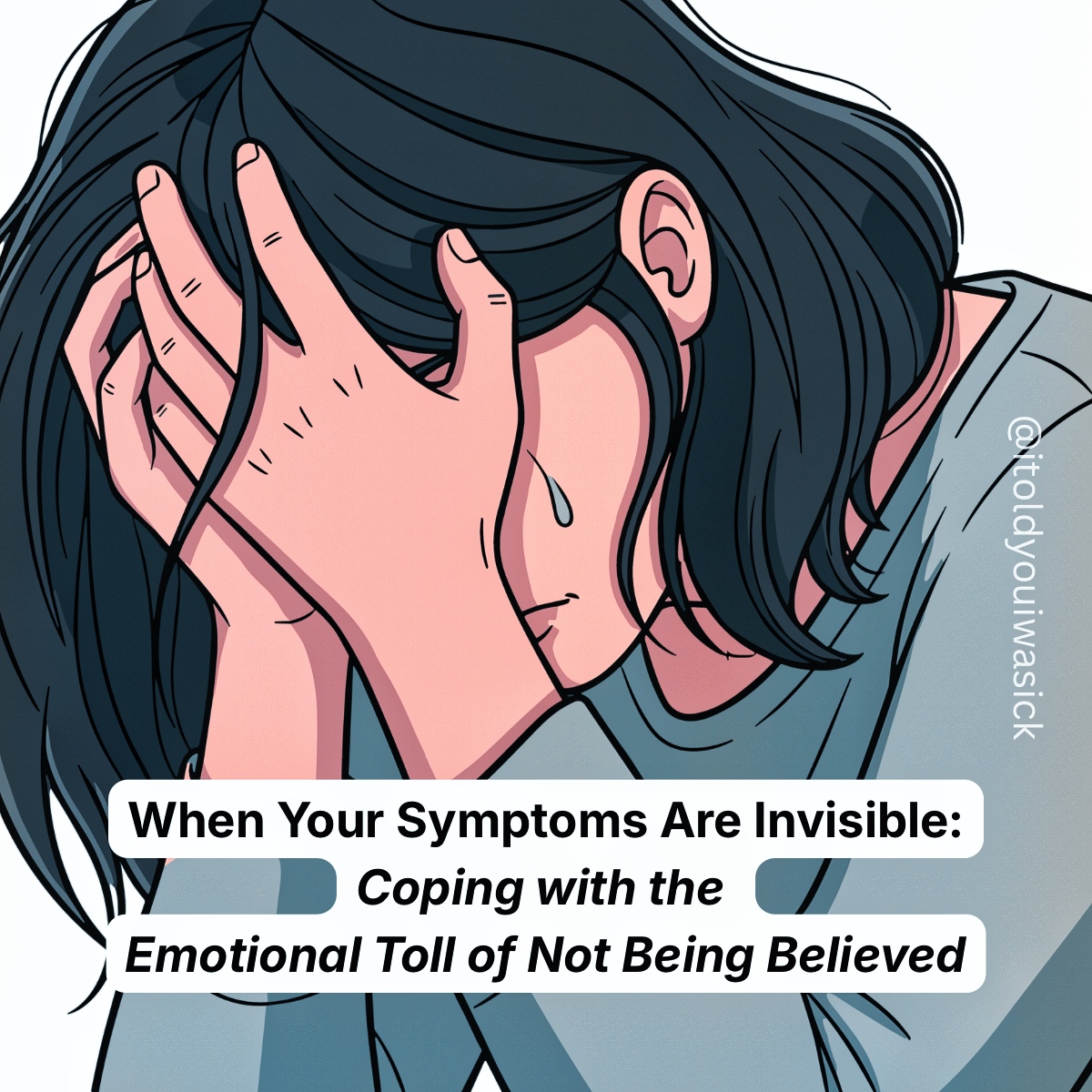

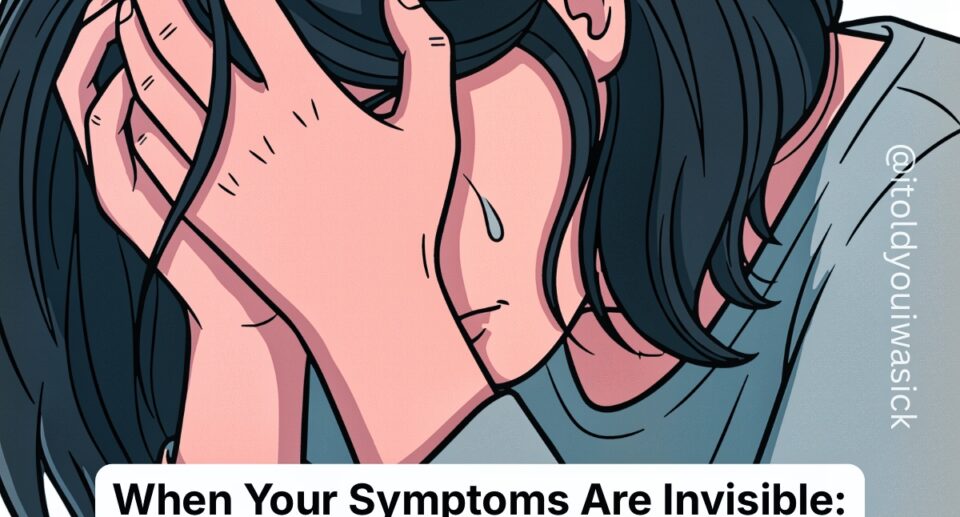
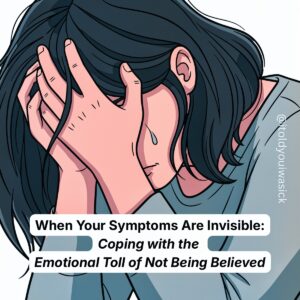
When Your Symptoms Are Invisible: Coping with the Emotional Toll of Not Being Believed

Don’t you hate it when you get up feeling as though you have been struck down by a truck? All the joints are sore, the head is cloudy, and you are tired to the very bone. But you see yourself in the mirror, and you look healthier than ever. Whenever your symptoms are not visible, even the people who are closest to you will have a hard time knowing what you are going through.
Having an invisible chronic disease, such as fibromyalgia, lupus, chronic fatigue syndrome, or POTS, one has to deal with special isolation. It has been discovered that only 6 percent of individuals with disabilities make use of visible aids such as wheelchairs; therefore, the majority engage in battles that no one can see.
“It has been discovered that only 6 percent of individuals with disabilities make use of visible aids such as wheelchairs; therefore, the majority engage in battles that no one can see.”
The Weight of Disbelief
The stress of not being heard adds to the pressure of being a patient with a chronic condition. Research shows that unbelief causes depression, guilt, frustration, and further isolation. When your family, friends, employers, or even healthcare providers doubt the validity of your pain, it causes you to always engage in a form of emotional turmoil, to explain and prove to them that you are actually suffering.
In a questionnaire conducted on more than 2,400 women with persistent pain, 83% of them stated that they had been subjected to gender discrimination by physicians. The message is made obvious: when your experience does not align with what illness is supposed to “look like”, it cannot be serious.
This poses a bitter paradox, whereby keeping your illness confidential, you shield yourself from judgments, but you feel alone. Sharing opens doors to be helped but at the same time, it opens the door to misunderstanding and discrimination.
When Self-Doubt Creeps In
The most pernicious one is, maybe, the way in which the external lack of belief will flow inward and make you doubt your own reality. Being constantly told that you look great or that the symptoms are psychosomatic, it is normal to wonder whether all of what you are experiencing is in your head.
Studies also highlight that this guilt is baseless, even though the blame on oneself is very common. Chronic illnesses are not inherent weaknesses but complicated biological facts. However, the psychological effects it brings result in a lot of misery to the physical.
Coverage in Self-Validation Strategies.
Build Your Inner Authority: Maintain a symptom diary of physical symptoms, emotional reactions, and patterns. This proves what you have been going through using solid facts and aids in determining what helps or hinders the operation.
Divide Worth and Productivity: Your product is not you. Acceptance and Commitment Therapy (ACT) has been shown to be effective in the management of fibromyalgia and multiple sclerosis by assisting people to accept limitations and find values other than achievement. Learn the difference between who you are and what you can do on any one particular day.
Find Your People: Support groups and community ties offer approval and relief against isolation. Condition-specific organizations and online communities are places where you can connect with people who have a real understanding of the condition and can share effective strategies to help you cope well.
Choose What to Disclose Selectively: You should not tell everybody everything. Prepare ready answers to various events. A quick “I am not well” to a regular work colleague and a more elaborate explanation to those you know well and medical experts. Family relations have a different set of challenges. Skepticism among them is oftentimes due to fear or inability to embrace change, and not due to malice.
Self-Compassion as Your Bedrock.
Self- compassion has three components that are especially useful with chronic illness: self-kindness (talking kindly to yourself), common humanity (suffering is universal), and mindfulness (seeing, not identifying with).
When thinking “I should be able to do this,” re-frame: “I am doing my level best with a hard situation.”
Moving Forward
Your pain is not imaginary, your struggle is not without reason, and you need to be supported and loved by people and yourself. The way out is not to get everyone to grasp but to develop self-trust to such an extent that it overcomes the doubt, develop shields, and find people who will see you even when your condition is hidden.
You are not imagining it. You are not weak. You are going through one of the toughest situations in life with incredible strength. It should be honored, although it may be only you who will be able to see it fully.
Learn how to better advocate for your health by picking up a copy of Advocate for Your Health: A Step-By-Step Guide to Navigating Medical Visits.

References
- Harvard Health Publishing. (2023). “Invisible illness: More than meets the eye.” Harvard Medical School.
https://www.health.harvard.edu/diseases-and-conditions/invisible-illness-more-than-meets-the-eye
- (2025). “‘Invisible diseases’ burden both body and mind. Can therapy help?”
https://psyche.co/ideas/invisible-diseases-burden-both-body-and-mind-can-therapy-help
- CBC Radio. (2022). “I was diagnosed with an ‘invisible’ illness. For years, my family didn’t believe my pain was real.” https://www.cbc.ca/radio/docproject/i-was-diagnosed-with-an-invisible-illness
- American Medical Association Journal of Ethics. (2021). “Invisible Illness and Measurability.” https://journalofethics.ama-assn.org/article/invisible-illness-and-measurability/2021-07
- Counseling Today. (2016). “The tangible effects of invisible illness.” https://ctarchive.counseling.org/2016/04/the-tangible-effects-of-invisible-illness/
- “Types of Invisible Disabilities & Where to Get Support.” https://www.resiliencelab.us/thought-lab/living-with-an-invisible-disability
- Psychology Today. (2022). “Can You Make Your Invisible Illness More Visible?” https://www.psychologytoday.com/us/blog/so-much-more-than-a-headache/202210/can-you-make-your-invisible-illness-more-visible
- National Institutes of Health. “Self-Efficacy of People with Chronic Conditions: A Qualitative Directed Content Analysis.” https://www.ncbi.nlm.nih.gov/pmc/articles/PMC6262549/
- “Psychosocial interventions for adults with newly diagnosed chronic disease: A systematic review.” https://pmc.ncbi.nlm.nih.gov/articles/PMC9092922/
- American Academy of Family Physicians. (2009). “Five Communication Strategies to Promote Self-Management of Chronic Illness.” https://www.aafp.org/pubs/fpm/issues/2009/0900/p12.html